
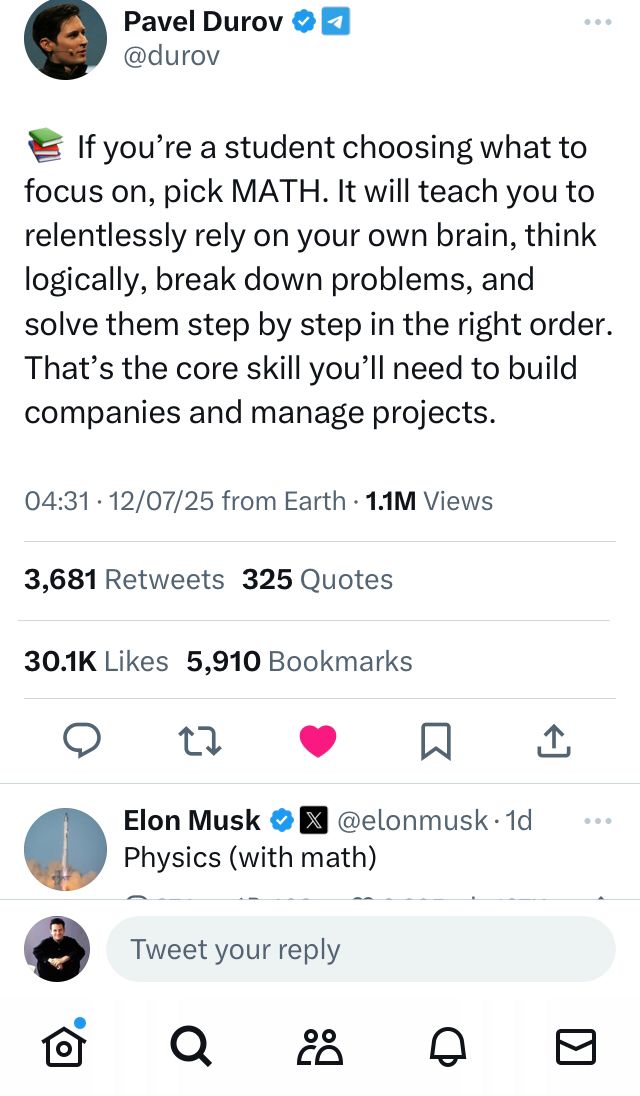
The day before yesterday, I read a tweet by Pavel Durov, the young founder of the Telegram app, on the social media app Twitter. He had written, “If you are a student and have to decide which subject to focus on, choose mathematics. It will teach you to rely on your own intelligence, help you think logically, break down problems, and solve each step in the correct order. This is the main skill you will need to build a company and manage projects.”
The above sentence is as is his tweet. Many of us know about the Telegram app. Its valuation (meaning market value) is 30 billion dollars, which is roughly equal to the current value of the tech company Wipro. The important thing is that Telegram has only about 30-50 employees, whereas Wipro has nearly two hundred thousand employees.
What is special is that Elon Musk, one of the richest people in the world and currently much talked about, also retweeted Pavel Durov’s tweet and emphasized the importance of “Physics with Math.”
Now, neither of them said anything new. From childhood, we are told to study math and science [and for Marathi medium students, English too]. If we want a bright future, we are told to focus more on these subjects. For this, we have done coaching, extra classes, and many other things, and we also make our children do the same.
Now, coming to the main point. When we were young, most of us were weak in English and Math. Some were naturally smart and did not find any subject very difficult. But even today, all of us have learned something somewhere. Some have advanced a lot, some are average.
But since Pavel Durov told us to focus on math, I was curious about his education. While searching on the internet, I found that his field of study was English Philology and translation — that is, the study of the English language, its history, literature, and culture. On further looking, I understood that although he was very advanced in computer programming, his formal education was in humanities.
Seeing this, I was confused. I wondered how this was possible.
Then I researched other people who made careers in programming or other computer fields—
- Michael Dell (Dell Technologies) – intended biology but dropped out with no formal degree
- Jessica Livingston (Y Combinator, investor in many tech startups) – B.A. in English
- Subroto Bagchi (Co-founder of Mindtree Infotech) – B.A. in Political Science
There are many such examples of people who built big companies in the computer and other fields without focusing on math or physics.
What I want to say is that focusing on a subject is good, but many people can easily solve math problems or memorize physics formulas but do not understand how to apply these in life.
In the above examples, no one formally studied computer programming, but today they have excelled in that field.
So, what is the use of stubbornly insisting on mastery in math, learning English, or focusing on only one group of subjects like science or math, and thinking only about careers as doctors or engineers?
Our method is only to score marks. We do not understand how gravity works or how electricity flows. We memorize lessons or poems in English or Marathi only to answer questions like “Explain with reference,” without ever understanding the essence of the lesson or poem.
When we graduate with degrees we do not want and enter the market, we become like bulls — working against our will. Those who don’t realize this try to find happiness in this bull-like work.
So, when someone tells you to focus on a subject, it becomes irritating. From childhood, we trap ourselves and the next generation to create work bulls just like us.
 Emotionsbyvijay.com
Leave a comment